Tuesday, November 13, 2012
More corner store ...
As a follow-up to the illustration of the corner store up the north-west corner of Cambridge and Gurner here is an archive picture from the City of Sydney. This was taken in January 1971 and is tagged by the council as being a restaurant (it is also tagged as being 'currently Wagner Art Gallery', which is across the road but hey that is close enough).
I can't make out any name but I guess it was the Spanish place La Bodega that I had read about earlier. Rob Hillier has a good black and white photo of it in his book "Let's Buy a Terrace House" (published in 1968). In the 1969 book, 'Paddington: an area of special architectural interest', the authors provide some brief notes in the back for a walking tour. Back then the shops at the corner of Cambridge, Gurner, Cascade and Hargrave were described as "along here you will find a print shop, a boutique, a Spanish-style restaurant and a Mexican art shop, newsagent, interior decorator, most of these are in charmingly restored old shops and houses".
Following is that vista taken in July 2012 ...
Friday, November 9, 2012
More house names
As a follow-up to the house name post we have sleuthed a couple more to add to the list. A birth announcement from the SMH on 13 July 1895 listed Peter Carter's wife giving birth to a son at "Arcadia", Cambridge Street Paddington.
We checked the Sands Directory to see if we could see which house Peter Carter was living in and according to the 1896 edition he was at 81 Cambridge street. Arcardia seems a pretty apt name for this house given that in the 1890s it would've commanded a vision of pastoralism in the form of the nearby dairy and the chinese market gardens!
The house was still referred to as "Arcadia" into the 1920s. The funeral notice for August Danker from the 4 October 1922 SMH says that it "will leave his late residence, Arcadia, 81 Cambridge street, Paddington, this day (Wednesday) at 2.00pm for the Waverley Cemetary. Masonic and other friends please accept this invitation."
The only trouble is that 81 Cambridge is now known as "Elgin". Looks like the etched glass above the door isn't original (I never really trust a name that isn't set in the render, although "Langlo" shows that you can tamper with that as well).
Another name to add to the list is for 48 Cambridge street, which was apparently known as "Perim" back in the day. Given that 46 - 52 were all on the same title, and built by the same builder, it made sense that 48 would've had a name although I don't know why it wasn't listed with the others in the Sands Directory. This name was sourced from the Paddington council rate books which also referenced the name occasionally. For the record, the north west end of Cambridge street ran "Candelo" (46); "Perim" (48); "Golspie" (50) and "Kibworth" (52). That is quite an international line up: Candelo is a municipality in Piedmont in Italy, 60 kms from Turin (okay, its also on the South Coast as we revealed earlier); Perim is an island at the entrance into the Red Sea; Golspie is a town in Scotland; and Kibworth is in Leicestershire, England.
Tuesday, November 6, 2012
Corner store sketches
Here is a Cedric Emanuel sketch of some corner stores, including the Gurner / Cambridge shop in the top right. You can just make out the "La Bodega" name on the door. Darcy's is still there although I cannot place the rest.
Friday, November 2, 2012
Charles Swinbourne
Charles Swinbourne lived in Cambridge Street in the 1890s. From 1894 to 1898 he lived at 25 Cambridge Street and then he moved down the hill to take up residence at 55 Cambridge Street until the early 1900s. The Sands Directory doesn't give much more information than that, apart from the fact that by 1900 he was listed as 'Swinbourne Charles, J.P." This last fact is confirmed by the SMH of 21 October 1899 listing Charles Swinbourne of 55 Cambridge Street Paddington in the roll of the magistrates of the colony of New South Wales that had been recently gazetted (JPs actually had a few powers and responsibilities back then and could sit in court for small matters unlike the "mere witnessing machines" they were to become by 1920s, that quote was a complaint of JPs back in the 20s).
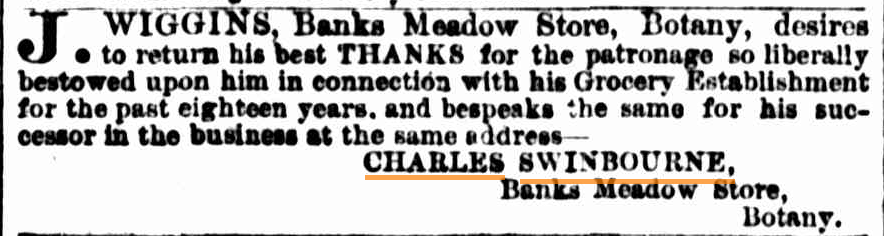
In looking up Charles' details on Trove there is reference to a Charles Richard Swinbourne who was an Alderman of the Botany Municipality from 1888 to 1892 and Mayor from 1891 to 1892. He was apparently instrumental in setting up the municipality and is likely the same Charles Swinbourne who took over the Banks Meadow Store in 1886 as referenced in the following advert from the SMH in June of that year.
Usually I would think that it was a coincidence but Charles Swinbourne is unique enough of a name to make me think that it could be the same person. You can double check this in the Sands Directory because in addition to the suburb listing they have a section which then lists everyone alphabetically where I confirmed my hunch that there was only one Charles Swinbourne around town in those days, and it looks like he also had a wool scouring business in Botany as well. Charles Swinbourne was also convinced to run for NSW parliament in 1898 for the seat of Botany. You can actually find the results of all old elections online, here is the link to the 1898 Botany election. There were 1,802 formal votes cast in the election, Swinbourne receiving 465 of them (26% of the vote). It was first past the post back then and the Labor candidate won with only 568 votes. Swinbourne, running as a National Federal, was hurt by the two independent federalist who combined for 248 votes between them, effectively costing the Federalists the seat. The overall NSW election of 1898 was won by the Free Trade Party of Sir George Reid with only 33% of the vote. The National Federalists received 43% of the state vote and the Labor Party 12%. The National Federalists were led at the 1898 election by Edmund Barton (later to be Australia's 1st Prime Minister). He was challenged by Reid to contest the seat of East Sydney, which Reid won. Francis Clarke was then required to vacate his seat of Hastings so that Barton could win the by-election and return to Parliament. Whilst campaigning as the National Federalists they were otherwise known as the Protectionists. Anyway, whilst I am sure you will agree this political history lesson is an interesting sidebar when do we get back to Swinbourne? Well, following is an extract account of a Swinbourne rally of July 1898 which gives some more details of his background. He gives the impression that he is not a resident of the area but a businessman and large employer of labour in the district. To me, this is consistent with him living on Cambridge Street in the fancy Langlo (or Glenelg as it was then known). Also, given his aspirations for public office in 1898 it is conceivable that he decided to become a JP in 1899.
In looking up Charles' details on Trove there is reference to a Charles Richard Swinbourne who was an Alderman of the Botany Municipality from 1888 to 1892 and Mayor from 1891 to 1892. He was apparently instrumental in setting up the municipality and is likely the same Charles Swinbourne who took over the Banks Meadow Store in 1886 as referenced in the following advert from the SMH in June of that year.
Usually I would think that it was a coincidence but Charles Swinbourne is unique enough of a name to make me think that it could be the same person. You can double check this in the Sands Directory because in addition to the suburb listing they have a section which then lists everyone alphabetically where I confirmed my hunch that there was only one Charles Swinbourne around town in those days, and it looks like he also had a wool scouring business in Botany as well. Charles Swinbourne was also convinced to run for NSW parliament in 1898 for the seat of Botany. You can actually find the results of all old elections online, here is the link to the 1898 Botany election. There were 1,802 formal votes cast in the election, Swinbourne receiving 465 of them (26% of the vote). It was first past the post back then and the Labor candidate won with only 568 votes. Swinbourne, running as a National Federal, was hurt by the two independent federalist who combined for 248 votes between them, effectively costing the Federalists the seat. The overall NSW election of 1898 was won by the Free Trade Party of Sir George Reid with only 33% of the vote. The National Federalists received 43% of the state vote and the Labor Party 12%. The National Federalists were led at the 1898 election by Edmund Barton (later to be Australia's 1st Prime Minister). He was challenged by Reid to contest the seat of East Sydney, which Reid won. Francis Clarke was then required to vacate his seat of Hastings so that Barton could win the by-election and return to Parliament. Whilst campaigning as the National Federalists they were otherwise known as the Protectionists. Anyway, whilst I am sure you will agree this political history lesson is an interesting sidebar when do we get back to Swinbourne? Well, following is an extract account of a Swinbourne rally of July 1898 which gives some more details of his background. He gives the impression that he is not a resident of the area but a businessman and large employer of labour in the district. To me, this is consistent with him living on Cambridge Street in the fancy Langlo (or Glenelg as it was then known). Also, given his aspirations for public office in 1898 it is conceivable that he decided to become a JP in 1899.
Tuesday, October 30, 2012
Woollahra Council Plaque Scheme
Woollahra Council has just launched a plaque scheme, kind of like the Blue Plaque scheme in London. Here is the link to Woollahra's. Now the plan is for council to put up four plaques during 2013, and community nominations for the first round of plaques are due in February. You can find the nomination forms on the council website.
I would love to see some plaques on Cambridge Street so encourage everyone to put in an application. There are quite a few notable residents that I have written about so far, the distinguished soldier, the famous poet, and the boxing champion to name but a few. There are even a few others I haven't got around to posting about yet, the diplomat, the Australian cricket captain and the accomplished artist (with work in every State Gallery and the NGA).
Wednesday, October 24, 2012
40 to 48 Cambridge Street
Here is another Cedric Emanuel sketch of Cambridge Street, again taken from his Paddington Sketchbook published in 1975. 46 Cambridge has the enclosed balcony look which has since been reversed.
Saturday, October 20, 2012
Subscribe to:
Posts (Atom)